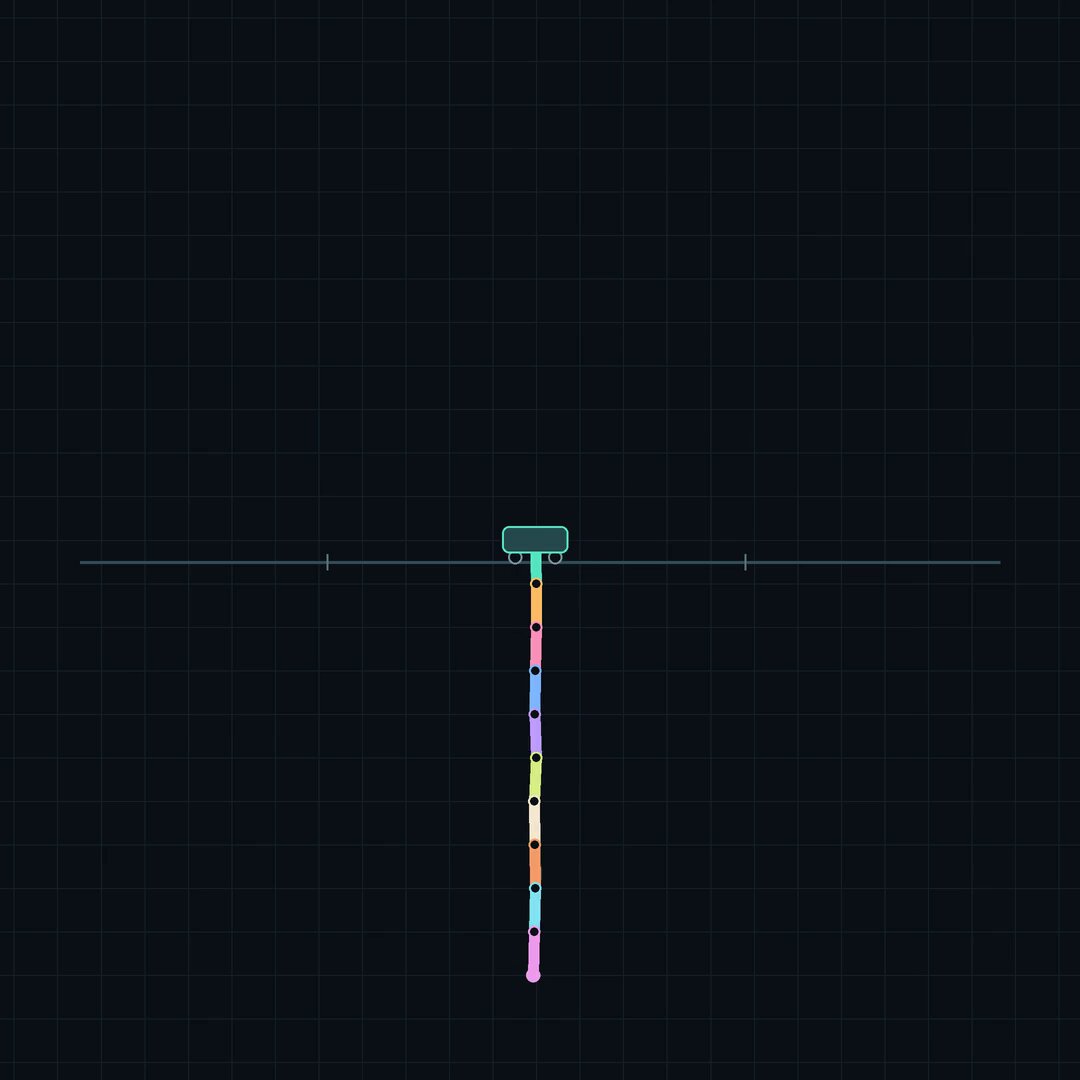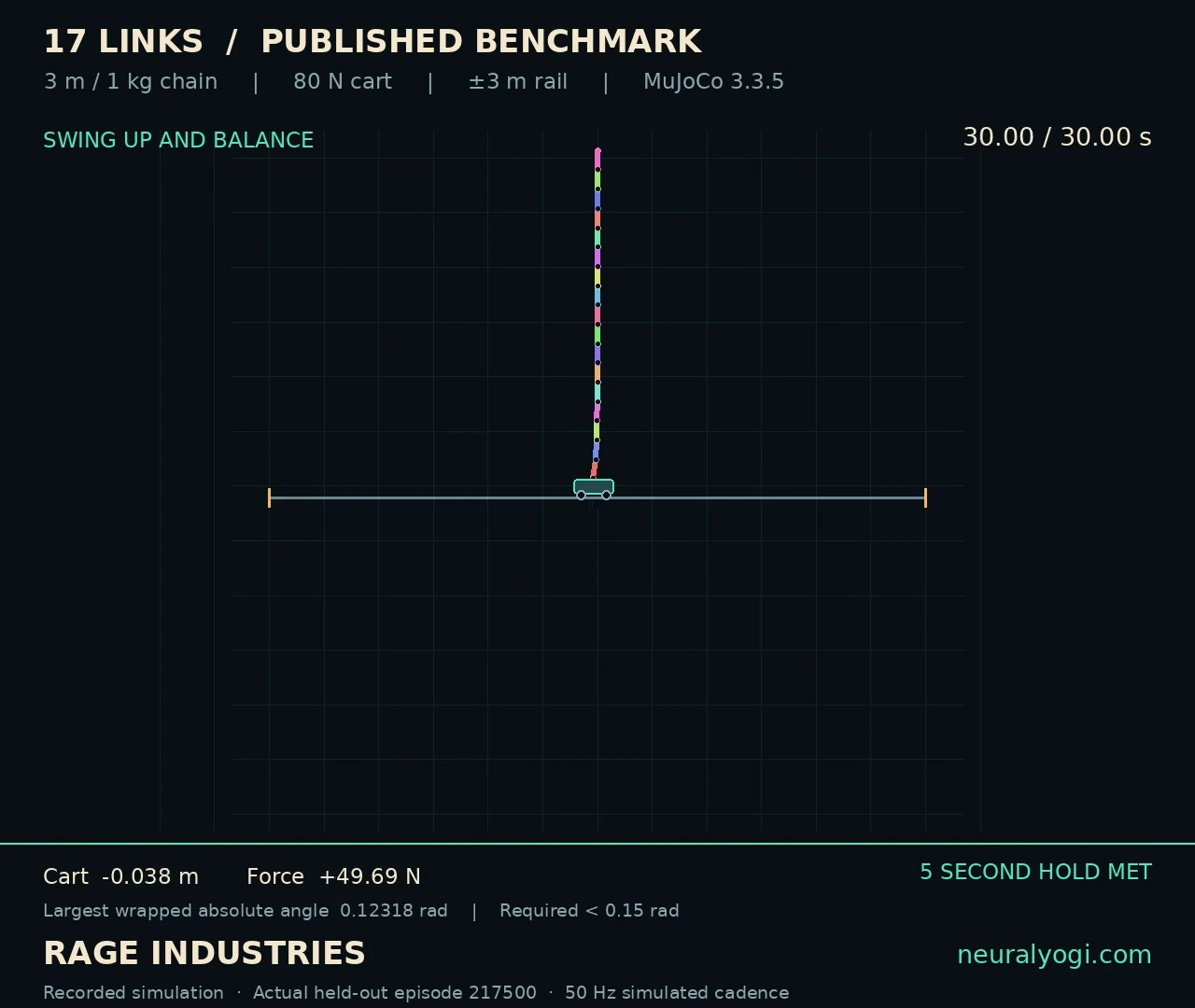
Seventeen passive pendulums. One cart motor. Start with the chain hanging, swing it upright, and keep every link inside a narrow angle window while the cart stays on its rail.
On October 16, Rage Mill passed all 141 reserved seventeen-link episodes. Every episode completed thirty simulated seconds and recorded 7.36 consecutive seconds upright, beyond the five seconds required by the task. Each reserved attempt ran once; none was replaced with a better take.
You can watch the actual replay at Pendulum Arena and download the frozen source and evidence.
The most useful part of the story is how we got past controllers that almost worked.
Give the number a rulebook
A pendulum count needs a physical model and a success test beside it. This campaign extends Corben Sorenson’s published fourteen-link task to seventeen, preserving the task’s constraints. His published benchmark is the foundation for this comparison.
The chain is three metres long and weighs one kilogram in total. The cart weighs another kilogram. All seventeen hinges are passive: we can command only the cart’s horizontal force, limited to ±80 newtons. The cart must stay inside ±3 metres for the entire episode.
Commands arrive at 50 Hz in simulation. MuJoCo advances four five-millisecond RK4 steps for each command, using the delivered float32 action. Success requires all seventeen absolute link angles, measured from upright, to remain strictly below 0.15 radians for 250 consecutive post-command states. That is five seconds, roughly within 8.6 degrees. There is no separate angular-speed gate.
The full thirty-second episode must finish without leaving the rail or resetting the physical state after initialization. A momentary upright pose cannot pass.
This is a different task from our earlier ten-link JEPA experiment, which used its own plant, actuator delay and acceptance criteria. That earlier result remains useful, but its numbers need their own context.
A better-looking plan could still fail
We started by checking seventeen’s mechanics and scoring against the published source. The chain has 36 state values: eighteen positions and eighteen velocities, counting the cart. Reusing sixteen-link tables would have skipped the problem we were trying to solve.
Then came route design and feedback. The route connects the hanging chain to a small bent orbit near upright. Finite-horizon feedback follows that route and maintains the motion. The orbit gives the controller a moving target within the upright window.
Several plausible improvements failed in actual simulation. Retiming a donor route with linear or Hermite interpolation produced smaller numerical errors after repair. Both resulting controllers left the rail without earning an upright tick. A stronger orbit and bridge did better, but its ordinary-feedback episode still escaped after 1,281 commands, with only 88 consecutive upright ticks.
Small cart offsets, alternative tracking penalties and finer orbit polishing also failed their tests. The experiment record keeps those outcomes.
The practical lesson was clear: reducing the discrepancy in a planned reference did not guarantee that feedback could capture and hold the actual chain. We needed to test the decisions made along the route.
Check the next force against the simulator
The successful controller retains a fixed reference and classical feedback. It adds a bounded search over possible cart commands using the native dynamics model.
For the first 850 commands, or seventeen simulated seconds, a parking controller lets the hanging system settle. At launch, the controller forecasts the complete remaining 650-command suffix from the observed state, using a separate simulator copy. It receives no seed or future recording.
During the active route, each decision evaluates at most sixteen distinct delivered float32 actions. For each candidate, the simulator predicts the next state. A precomputed finite-horizon value function scores that state’s tracking error together with the command’s deviation from the reference force. The controller chooses the first candidate with the lowest score.
In plain language: observe the chain, try a bounded set of forces in a model, compare their predicted consequences, and apply the selected force. Then observe again.
The value calculation uses a 700-command design; the actual episode uses its first 650 route entries. That distinction matters because the controller’s estimate of what remains extends beyond the commands it will execute.
This combination produced the first successful hanging-start diagnostic: all 1,500 commands completed, with 368 consecutive upright states. A promising run gave us a candidate to qualify.
Freeze it, then test fresh starts
The unchanged candidate passed exact source calibration, then two disjoint fresh development cohorts: 20/20 and 100/100. After the source and runtime freeze, it faced the reserved evaluation:
| Reserved cohort | Passed |
|---|---|
| Noisy hanging starts | 20/20 |
| Additional noisy hanging starts | 100/100 |
| Exact hanging resets | 20/20 |
| Noisy video episode | 1/1 |
Every reserved episode held upright for 368 ticks, or 7.36 seconds. Maximum cart excursion across that cohort was about 1.94 metres, inside the three-metre limit. The exact-reset cohort repeats the deterministic hanging condition; it is separate from the noisy starts.
Including calibration and development, the fixed candidate completed 262 scored episodes and 393,000 commands. Earlier failed diagnostic candidates remain outside that total, preserved in the experiment history.
We also checked the recordings beyond their scores. Separate native replay checks reproduced calibration and all 141 reserved tapes: 142 episodes covering 213,000 unique commands. Causal policy reconstruction checked the raw commands, delivered actions, selected next states and complete launch forecasts against the saved evidence.
The original reserved runs did not retain their inner candidate ledgers. The later policy proofs reconstruct those decisions from recorded inputs, with their own measured costs. They do not retroactively become original-run counters.
Where JEPA fits in this result
The earlier ten-link work put a learned encoder in the state-recovery path before classical feedback. For seventeen, we separately tested an action-conditioned JEPA on a narrower job: ranking offline route initializers before native repair.
That experiment failed its declared forecast, action-response and ranking gates. Its learned ranking matched the untrained random model’s order. No learned proposal was adopted, and no learned controller supplied the successful cart commands.
The seventeen-link result therefore belongs to classical model-based control. The learning experiment remains a useful negative result: it tells us that this particular small model and training setup had not earned the proposed job. It leaves room for a better learning experiment with the same requirement to demonstrate benefit.
Make the replay inspectable
The arena’s featured video comes from reserved noisy seed 217500. It shows all 1,500 post-command samples, uncut, at fifty frames per second. Force, cart position, maximum link angle and accumulated hold time come from that actual tape. Rendering the video runs no controller or dynamics.
Pendulum Arena brings the replay, exact protocols, frozen artifacts and result history together. It also has a separate browser toy for getting a feel for the problem. That toy uses separate physics and produces no ranked benchmark score.
The result is listed as author-attested. Checks implemented separately within our work support the evidence; third-party reproduction remains open. So do hardware transfer, robustness to new disturbances and wall-clock real-time execution. Fifty hertz describes the simulated command cadence; the launch forecast exceeds a twenty-millisecond wall-clock deadline. Global record priority is unverified.
Rage Industries is where I write about the engineering. The arena is where you can watch, inspect the conditions and challenge the result. Keeping them connected gives the work both an explanation and a place to be tested.
If you want to pull on the thread, start with the seventeen-link release. If you’d like to help me keep making time for Rage Mill, support the work on Ko-fi.